
Tooth pain has a way of stopping everything, usually at the most inconvenient moments. Whether it’s a molar that has been silently failing for months or a tooth that’s become suddenly painful, there are times when saving a tooth just isn’t possible. When those moments arise, removing it is the most important step toward relieving pain and protecting the rest of your smile. Understanding when an extraction is necessary, and what to expect from the process, makes the experience far less intimidating.
At Pine Glen Dental Group, we approach tooth extractions in Peoria with the same meticulous care that has defined our practice for more than two decades. Dr. Lori Rice and Dr. Jacey Thelen, D.D.S., lead our team with the precision and attention to detail this practice has built its reputation on, and our patients leave knowing that they were treated by someone who genuinely took time with their case. As part of our broader general dental care in Peoria, extractions are performed with patient comfort and long-term oral health as the primary goals.
Your Extraction Visit, Step by Step
When Is a Tooth Extraction Necessary?
Not every troubled tooth needs to come out. Our dentists will always exhaust restorative options first, whether that means a filling, crown, or other treatment. However, there are situations where extraction is the most appropriate method.
The most common reasons a tooth may need to be removed include the following:
- Severe decay: When a cavity has progressed too far to be repaired with a filling or crown, extraction prevents the spread of infection to neighboring teeth.
- Advanced gum disease: Significant periodontal breakdown can loosen a tooth to the point where the surrounding bone can no longer support it.
- Dental trauma: A cracked or fractured tooth that can’t be restored structurally may need to be removed to protect adjacent teeth and tissue.
- Impaction: Teeth that are trapped beneath the gumline or growing at an abnormal angle, which most often occurs with wisdom teeth, can cause crowding, pain, and infection.
- Preparation for restorative work: In some cases, an extraction is the first step toward a broader restoration plan, such as dental implants or bridges.
Each of these situations is different, and your treatment plan at Pine Glen Dental Group will always reflect what is best for your specific needs.

What to Expect During the Procedure
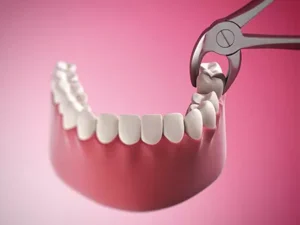
Knowing what happens during an extraction helps remove the uncertainty from the process. According to MedlinePlus, a simple extraction involves loosening the tooth with a dental instrument called an elevator before removing it with forceps. It’s a process that is performed under local anesthesia to keep you comfortable the entire time.
Simple vs. Surgical Extractions
There are two main types of extractions, and the one recommended for you will depend on your tooth’s position and condition. A simple extraction is used for teeth that are fully visible above the gumline, and our dentists perform these in-office. A surgical extraction is needed when a tooth is impacted, broken at the gumline, or otherwise not easily accessible; for these more complex cases, we coordinate with a trusted oral surgeon so you receive the right level of care. Dr. Rice or Dr. Thelen will explain which category your extraction falls into and what to expect before any treatment begins.
After the Extraction
As for the recovery after a tooth extraction, most patients experience mild soreness for a few days, which can be managed with over-the-counter pain relief and the post-operative instructions provided at your visit. You’ll receive specific guidance from our team on what to eat, how to care for the site, and when to follow up. Detailed patient care instructions are also available through our patient instructions resource, which you can access at any time for reliable guidance on hand.
Tooth Replacement Options After an Extraction
Removing a tooth is only the first step when an extraction is required. Leaving a gap in your smile can shift neighboring teeth, affect how you bite, and accelerate bone loss in the jaw over time. That is why we discuss replacement options with our patients before or shortly after an extraction, giving you a clear, full picture of what comes next right from the start.
For many patients, dental implants are the top choice for replacing a missing tooth. They restore full function, look natural, and support long-term bone health. For those who prefer a non-surgical option, a dental bridge can effectively close the space using the adjacent teeth for support. Dr. Rice or Dr. Thelen will thoroughly explain which one makes the most sense given your health, budget, and goals.
Choose Pine Glen Dental Group for Tooth Extractions in Peoria, IL
Pine Glen Dental Group has served the Peoria community for more than two decades, and the standard of care has never wavered. Dr. Lori Rice, who joined the practice in 2002 and purchased it in 2012, graduated at the top of her class from Loma Linda University’s School of Dentistry. She’s joined by Dr. Jacey Thelen, D.D.S., a UMKC graduate and Peoria-area native who came on board as an associate dentist in 2026. Our practice holds a BBB A+ rating, a 4.7-star Google rating, and has been named a Nextdoor Neighborhood Favorite every year from 2018 through 2024. Every patient who walks through our doors is treated as an individual, not a file number, as our philosophy is to treat everyone the way we want to be treated.
As a fee-for-service practice, we work with patients on their out-of-network insurance claims and submit on their behalf to help maximize benefits so that cost is never standing in the way of getting the care you need. We accept cash, personal checks, Visa, Mastercard, American Express, and Discover, and our team is happy to discuss your options before treatment begins. If you’ve been told that a tooth may need to be removed, schedule your appointment with Pine Glen Dental Group today.